Tuesday, 25 March 2014

Looking for fakes and doubts

I wonder what I’m doing right now; what I’ve been doing all this time; what I’m going to do in the time to come. The professional life I’ve been leading so far has been successful, to say the least. I’ve seen paintings nobody has even dreamed of touching. I’ve discovered flaws in the most perfect of works. But what am I? A hunter of mistakes? A soldier enlisted in the army that counters counterfeiters?


I seem to delight only in the wrong-doings of others. I often think of where I am in this picture, working as I am in backgrounds, an extra in a film where the leading role is too prominent to allow the rise of the underlings. I’ve been the shadow of Pissarro, of Matisse, of Caillebotte, of Toulouse-Lautrec. The funny thing is they’ve been all dead a long time; too long to know that I’m crusading for the keeping of their good names.
But art has made me happy. There is this thrill I get when I come close to a painting. It’s nothing to me but an object: a thing on a wall with a life of its own, a life on the verge between fact and fiction. Yes, assessing art does precisely that: puts pressure on the line between originals and fakes, between the real thing and the copy claiming to be it. And I’m the one who’s always there, walking that line.

This is what I usually work against. The best of the best have put their minds
to fool the world, and I am the one who's trying to stop that catastrophe
from taking place. I almost sound like Bruce Willis, don't I?
The other day, I was handling a Pissarro. The work was perfect. It spelled Pissarro all the way. The colour pallet, brushstroke, frame, light, theme, composition. Everything. The purchase was on its way. The dealer I worked with, a close friend of mine, was eager to get the contract signed. It was so good and the share so impossible to turn down. And on top of that he was, indeed, my friend.
“Jesus, James!” he said to me, not just once. He wanted everything done. He wanted my tick – nothing else. A simple tick, a simple flick of the pen on a piece of paper. But, friend or no friend, I couldn’t do it. Not for all the millions in the world. There was this shadow lurking inside my brain that told me no, this is not it. You need to look again. And again. And again. I’d even talked to my mentors about this piece. I’d spoken with my professor at Courtauld, and he took time off to examine this Pissarro with me. He found it very close to an original: the closest a painting can be. But when everybody had agreed, and all loose ends had been tied up, I was still unsure. The monster gnawing at my thoughts was well and alive. And it was then that I saw it. A little flaw in the signature. The ‘a’ ever so slightly different, not impressed into the layer of paint underneath it. As if it had been put there at a later date, when the paint was dry. The only detail that quieted the monster inside me was there, and I rejoiced.
How sad my friend was! He had just lost one of the best deals in a decade. He looked at me like he was going to eat me alive. But he knew I was right. He won’t take it personally, because that’s exactly what I’m trained to do and what he hires me to do: to find forgery where everybody else sees perfection.

The secrecy of my profession doesn't allow me to talk about the piece I investigated.
But this is Pissarro, the way the world admires him. Boulevard Montmartre (1897)
Source: Wikipedia
That’s my life: always acting against my best judgment, always doubting my doubts, always looking for what hasn’t been seen. And on top of all this, my life is the disappointment of others. But I can’t help it. This is my greatest delight, my doom. So what am I? What?

Sunday, 2 March 2014

Picasso and Matisse in 1935

In 1935, after his first wife, Olga Khokhlova, left him because of the affair he was having with the French Marie-Thérèse Walter and (soon after) with Dora Maar, Picasso experienced a breakdown which caused him to turn painting down for a while and go straight for poetry instead. Writing, it appears, provided him with relief. All turned quickly into a flood of creative output not unusual to Picasso. He wrote a book-load of poems, experimented with words, gave word-crafting a good try.

Picasso's poetry edited by Jerome Rothenberg and Pierre Joris
via www.exactchange.com
On the artistic side of things, there may be another explanation for Picasso’s withdrawal. As Gertrude Stein suggests in her famous monograph, he had decided to give up painting (and drawing too) after he’d been through almost eight years of search for artistic answers to the problem of colour. This is a period when “Picasso had the tendency to console himself with Matisse’s conception of colour,” which, however, made things worse. It isn’t clear how affected Picasso was by the change, although Stein conjectures that he was never fully content, in spite of rather enjoying the two years without responsibilities, when he dedicated his time to writing poetry in a café.
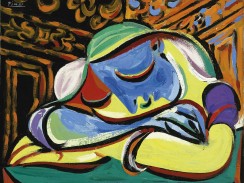
The last painting work of Picasso’s that year, Jeune Famme Endormie, is almost a foresight of the state of slumber in which his painting fell between 1935 and 1937.

Matisse paintings from 1935

So while estranged from painting, the year 1935 doesn’t seem to have been entirely unproductive for the Spaniard. However, the question I found myself asking is: what was Matisse doing at that time?
It turns out he was doing a lot. Of painting, that is. 1935 is the year when he produced the famous suite known as The Pink Nude (also as Large Reclining Nude), which made the world of art go mad with the idea of recording, in visual details, the progression of a work of art.


The 22 versions painted that year are regarded as an important stage of transition between Matisse’s earlier figurative works and the cut outs that will dominate the last years of his career. As in the case of Picasso, the model for this series was a woman close to artist: Lydia Delectorskaya, the Russian assistant who featured in many other Matisse paintings. She was not his mistress, but they seem to have been emotionally very connected.
In the same year 1935, we also find Matisse painting The Dream. The figure strikes a pose patently similar to that of Picasso’s Woman with Yellow Hair (1931). Which stands to show, once again, the extent to which the two artists emulated each other.
As a side note, Picasso himself had painted his own Dream three years earlier, using as a model his French mistress (then only seventeen years of age).

Picasso, The Dream (1932)
via Pinterest
Picasso, Woman with Yellow Hair (1931)
via Pinterest
The reclining figure in this Matisse painting appears to be that of Lydia Delectorskaya, his assistant
Matisse, The Dream (1935)
via Pinterest

What 1935 meant to others

1935 did not stand still. This is the year when René Magritte executed the second painting bearing the title Human Condition – one of the many trompe l’oeil exrecises of the Belgian surrealist who made illusion into his patent. The other painting of the same title had been made by Magritte only two years earlier. A prolific year for him too, if we also consider The Portrait, his witty play on facial compositions.

Magritte, Human Condition II (1935)
via Pinterest
Magritte, Human Condition I (1933)
via Pinterest
And speaking of illusions, M.C. Escher too produced Hand With Reflecting Sphere, in the same year.
If we turn to a different side of art, one that is both avant-garde and Spanish, like Picasso’s, there’s Joan Miro’s Man and Woman in Front of a Pile of Excrements.

Miro, Man and Woman in Front of a Pile of Excrement (1935)
via Pinterest
Year: 1935. Miro, who also worked on some collages between 1935 and 1936, Metamorphose.

Painters who wrote

Picasso’s turn to poetry marked a cataclysmic interruption to his painting career, no doubt. One that lasted for only two years, but which managed to welcome poetry among his creative tendencies.
But then, of course, his poetry bypass is not that surprising. Artists dipping their creative fingers into the writing of poetry did exist before Picasso. Say Michelangelo (“Great beauty spreads a firestorm / across a thousand ardent wills”), say Salvador Dali (“Narcissus, / in his immobility, / absorbed by his reflection with the digestive slowness of a carnivorous plants, / becomes invisible”), say the true hybrids, like William Blake (“Ah Sunflower, weary of time, / who countest the steps of the sun”) or Dante Gabriel Rossetti (“At length the then of my long hope was now”).
Truth is, migration to and from poetry and to and from painting happens. No blame on anyone of those who did it. Picasso least of all.

Friday, 28 February 2014

Munch, briefly again

I just found this reportage/interview that takes a quick stroll through the work of Edvard Munch.


I wanted to embed it on my blog because The Sick Child mentioned in my previous post also features here (although not much discussion has grown around it). The video also caught my attention because it shows images from the Munch Museum in Oslo (where the exhibition Munch 150 was held last year), and because it uses the director of Munchmuseet, Stein Olav Henrichsen, as a valid source of information. A feat of advertisement, no doubt, but one not to be disparaged because of that.

Wednesday, 26 February 2014

Munch and his obsessive road


It took me a good two hours today to browse through the voluminous Edvard Munch: 1863-1944, the catalogue of the exhibition Munch 150, held at the Nasjionalgalleriet and the Munch-museet in Oslo between June and October last year.


I happened to be in Oslo in early September and I saw the exhibition – both sections of it, organized as they were chronologically (the 19th-century part at the National Gallery, and the 20-th century part at the Munch Museum). I was impressed. The curators had done an incredible job at bringing together exhibits from collections throughout the Scandinavia, England, France, Spain, Britain, and the States.
Then I bought this catalogue last week. 417 pages – a proper Munch overdose. It reminded me straight away of a question that had been gnawing at my brains for a long time: what is that railing that slashes through the panels in some of the paintings in the cycle known as Frieze of Life? I remember when I saw them together in the exhibition I thought those railings were so abrupt, so outstanding – unequivocal solutions to the problem of pictorial perspective, but so much more than that. I thought they looked like knife slashes. So much so, they made perspective painful.
It turns out, as Hans-Martin Frydenberg Lfaatten shows in an article he wrote for the catalogue, the railing featuring in Munch’s paintings (notably in The Scream, Despair, or Anxiety) demarcates a real place in Oslo (or Kristiania, as it was known in the nineteenth century).

Anxiety
Source: www.edvardmunch.org
The Scream
Source: Wikipedia
Despair
Source: Tumblr
      
This is Ljabro Road, “a popular excursion spot with a panoramic view”. It led to the Munch family residence, at Nordstrand, in the southern part of the city, and “was also the traditional vista for cityscapes and postcards depicting Kristiania” in the late nineteenth ce$ntury.
I wish I’d known that when I was in Oslo. I would have gone to the right spot (the Utsikten, in the neighbourhood of Ekeberg), to contemplate the city through the winding perspective of that Ljabro Road. I would have seen the city the way Munch saw it.

Ekeberg in Oslo, the place where Munch stood to paint The Scream
Source: The Telegraph

Like many other things in Munch’s oeuvre, this road, with its divisional railing that features so central in the scenes, is another of his obsessive returns to major themes, his repetitions of shapes and structural elements. Munch is known for the extent to which he altered, reworked, and reshaped his paintings, not in order to correct but in order to adjust to his mental status quo. He was very much influenced by his own moods, or by the place where he resided while working on a particular piece. This is visible, for instance, in the many instantiations of The Sick Child, which he painted in Oslo, in Paris, then in Oslo again. The Paris version is more colourful, more hopeful, one would say, whereas the Norwegian versions scream through the very materiality of the paint. It looks as though the canvas has been scratched by the talons of pain – a scream of terror in itself.

Matisse and Munch, similar but so different
The Sick Child
Source: www.edvardmunch.org

But that, of course, is another Munch topic.

Tuesday, 18 February 2014

Henri Matisse Cut Outs 2014

What's the big thrill this year in the world of art? Twitter is abuzz and there's good reason for it. Of course, Tate Modern is hosting a Matisse exhibition, starting April 17th.
The exhibition, featuring a considerable display of Henri Matisse's cutouts, promises a lot. Reading from Tate Modern's website:
From snowflowers to dancers, circus scenes and a famous snail, the exhibition showcases a dazzling array of 120 works made between 1936 and 1954.
The number of exhibits is not the only outstanding aspect. As the museum points out, not without a dab of pride at being the owner of some of these cutouts, the exhibition of this year makes it possible for a large number of these artworks to stand beside each other for the first time since the date of their creation.
A photograph of Matisse’s studio reveals that these works were initially conceived as a unified whole, and this is the first time they will have been together since they were made.
So the yellow background of the official poster will be a major glow at Tate's, where the Matisse cutouts will be on display until September 7th, after which they leave for New York, where they will be lodged at the Museum of Modern Art for another four months. Plenty of time to pay a visit, or even more than one.
NB: They're even making changes to the usual routine, because (n'est pas?) the Master deserves special treatment.
For the first time at Tate Modern, Sunday evenings will be set aside for a quieter exhibition viewing experience of Matisse: the Cut-Outs, with visitor numbers restricted from 20.00–22.30.0

Among the numerous Henri Matisse paintings available, cut outs were his most famous inventions, a technique that changed the way paintings are made

Wonder how these simple yet greatly evocative paper cutouts were made? Not much technical prowess, but of course, a lot of finesse. Plus, as we know, it's not the maneuver that matters. What's more important is the idea behind the line. See Matisse himself at work, at a late stage in his life, when he had almost completely surrendered to the technique he had made popular:


It's the simplicity of the whole ritual (Matisse, himself a person of many minute rituals): the way the gesture (not the hand!) cuts through the frail material to compose bi-dimensional objects; almost like a child's play.

In the meantime, a smaller exhibition is taking place in Southport, where lithographic copies of Matisse's cutouts are on display for a month (ending on the 16th of March).
And they're not alone. In a few days, an exhibition is opening in Ferrara as well, focused on Matisse's paintings from earlier stages of his career. For those who understand Italian, here's a video I've just fished off YouTube:


Quite a year for Matisse, indeed. 145 years from his birth, 60 years from his death. Richly marked by various events of this kind, the world over.